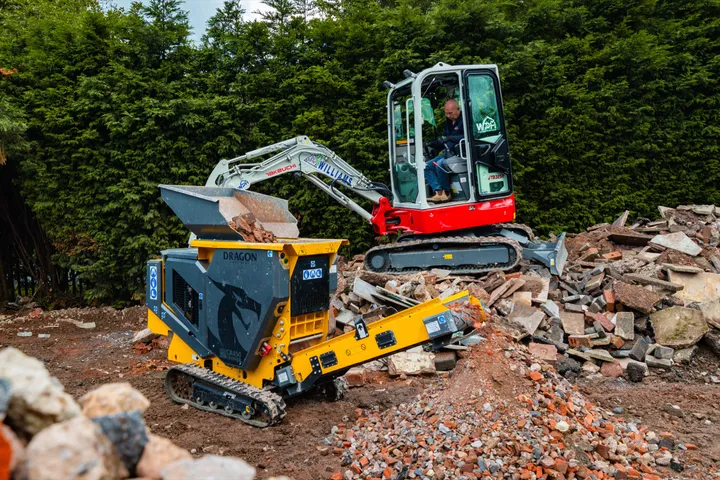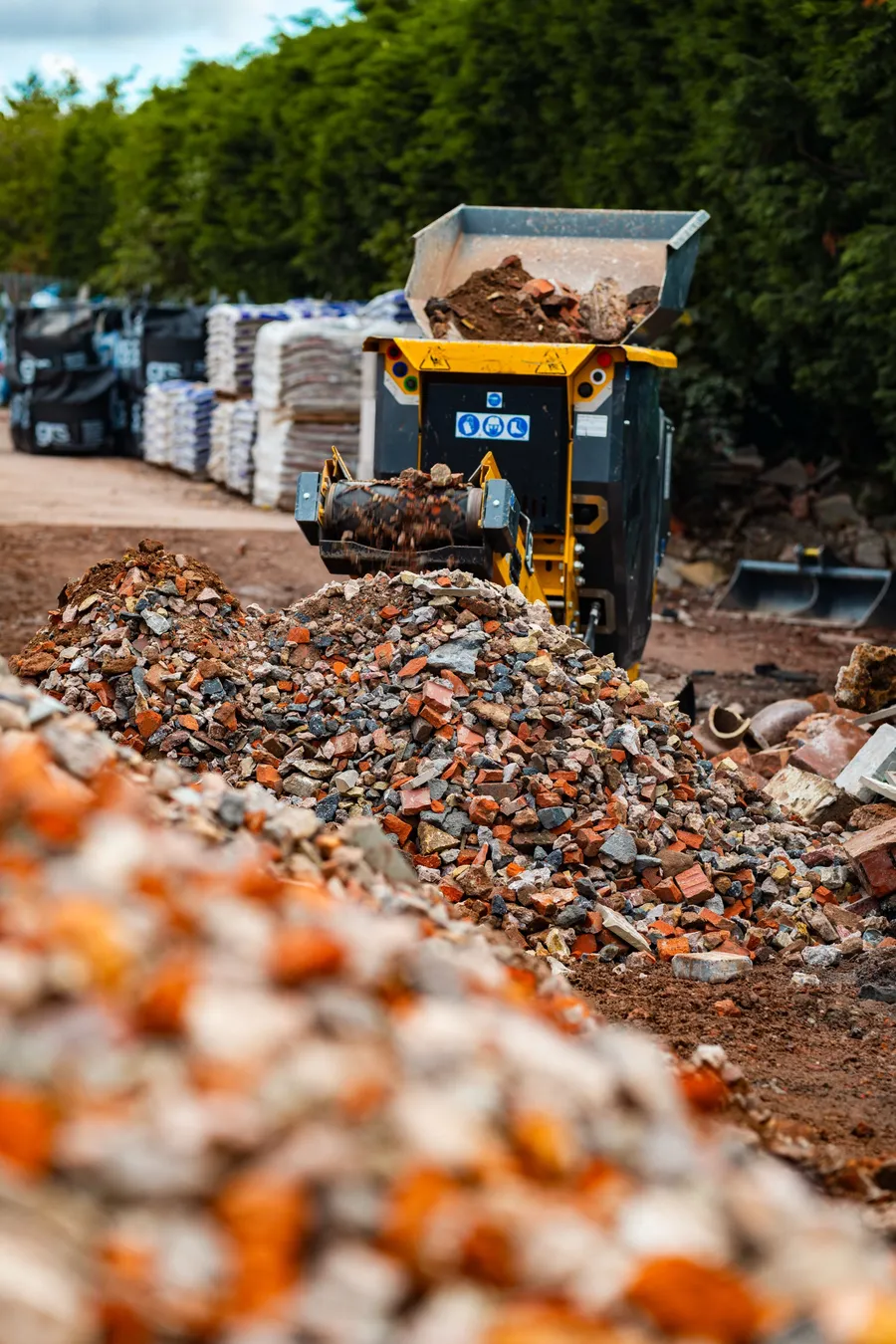
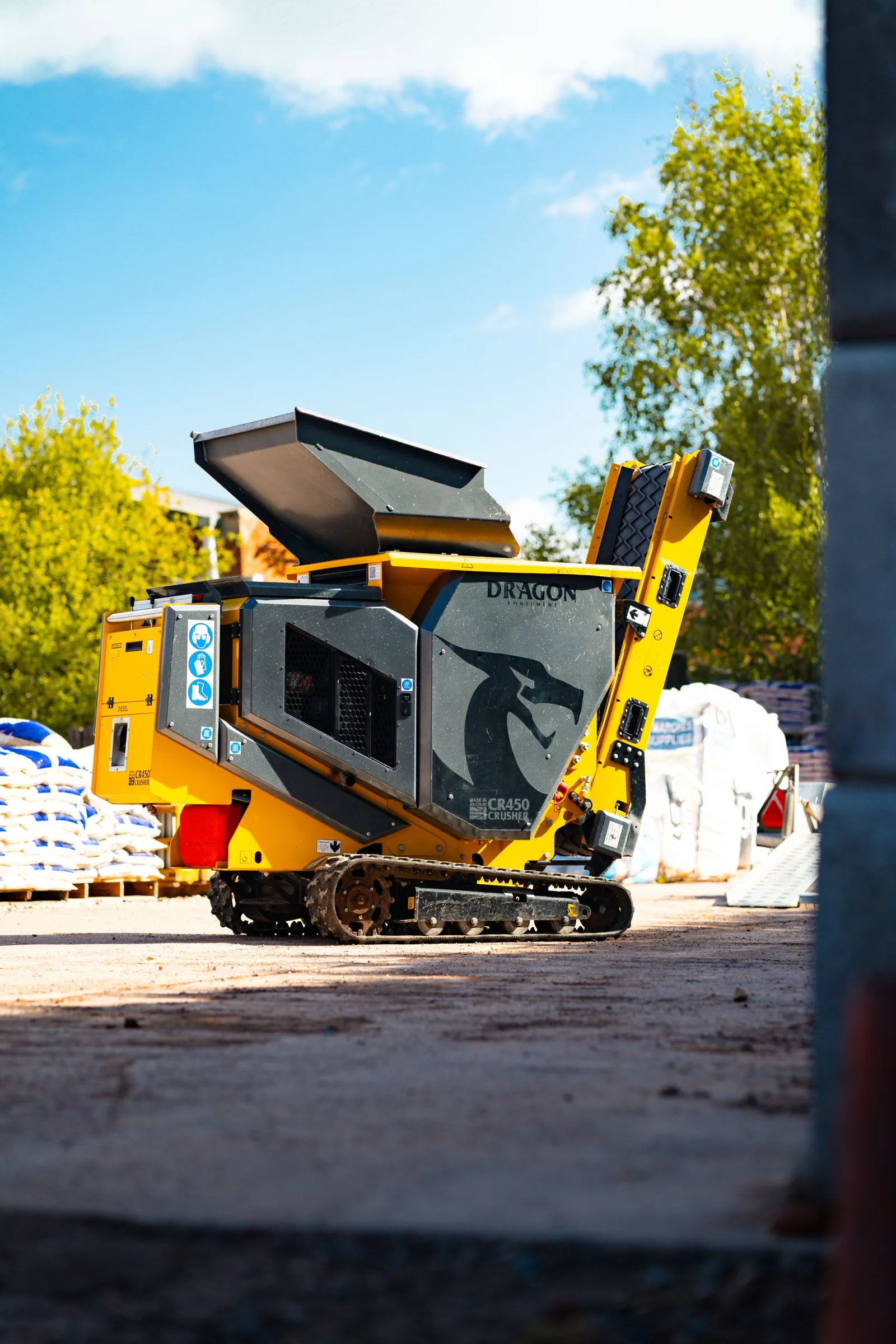
Yes, we deliver the Dragon Equipment CR450 self-hire crusher to Ludlow. It is about 33 miles from our yard at Ford, a straight run down the A49 through Church Stretton and Craven Arms, so allow roughly 55 minutes with the trailer. We bring it to site, give you a handover on the controls and collect it at the end.
- From our yard
- About 33 miles · 55 mins
- Route
- A458 to Shrewsbury, then the A49 south via Church Stretton and Craven Arms
- Council
- Shropshire Council
- Waste regulator
- Environment Agency
Why is on-site crushing worth it in Ludlow?
Ludlow's centre is a 12th-century planned grid on an escarpment above the Teme. Wide main streets are crossed by narrow side streets, and the castle and town walls are Scheduled Monuments. There are around 426 listed buildings inside the Ludlow Conservation Area alone. Every load of rubble that leaves a job, and every load of stone that arrives to replace it, has to come through that townscape or around it, so fewer lorry movements count for a lot here.
Crushing on site takes care of both trips. The CR450 turns broken concrete, brick, block, slabs and tarmac into graded hardcore from 3 to 55mm, which goes back in as sub-base or backfill on the same job. Ludlow is a small town, with 10,039 people at the 2021 census and about 5,537 households across its three wards, and a lot of its work is drives, yards and single plots, which suits a compact machine.
What are Ludlow's houses built from, and what comes out of them?
Outside the medieval and Georgian core, Ludlow spread after the railway arrived in 1852, when Gravel Hill and Steventon grew quickly. Both are now conservation areas in their own right. Sandpits was the town's early council estate, with its first homes built under the 1919 Addison Act and more added in later decades, and Connexus began refurbishing 77 homes on Sandpits Avenue in 2021. Victorian terraces and older council houses tend to give up brick outbuildings, yard concrete and worn paths.
The 2021 census counts 1,783 detached, 1,587 semi-detached and 1,571 terraced households across Ludlow's wards. Ludlow South leans hardest towards detached homes, with 883 of its 1,777 households living in one. Bigger plots bring bigger concrete drives, garage bases and patios. When one of those is replaced, the old slab can be broken out, crushed and spread back as the bed for the new surface, with nothing going to landfill.
Why is Ludlow growing east of the A49?
SAMDev set Ludlow about 875 homes and at least 6ha of employment land for 2006 to 2026, and because the historic core has to be protected, most of the new land lies beyond the bypass. The housing allocations are land south of Rocks Green (about 200 homes) and land east of the Eco Park (about 80). Employment land sits east of the Eco Park (2.5ha) and south of Sheet Road (3.5ha), and the gap between the Eco Park and Rocks Green is flagged as a possible growth area after 2026.
Rocks Green is where the digging is. J Ross Developments won hybrid consent for up to 200 homes in January 2019, reserved matters for 67 homes in phase 2 were approved in September 2022, and 61 more in phase 3 followed in December 2025, with the phased build under way. Shropshire's draft Local Plan to 2038 was withdrawn in July 2025, so these allocations still matter. All of it is reached off the A4117 and the bypass, well away from Broad Street.
What do the Teme, the Corve and the conservation areas mean for site work?
SAMDev names the Rivers Teme and Corve as physical limits on where Ludlow can grow, and the Environment Agency runs separate flood warning areas for each river at Ludlow. The town's Place Plan also lists flood risk management among its infrastructure concerns. Out in the hinterland, Bitterley parish suffers flash surface-water flooding from streams running off Clee Hill. If your job is close to either river, think about timing and where the stockpile of crushed material will sit.
There are four conservation areas: Ludlow itself, Galdeford, Gravel Hill and Steventon. SAMDev requires all development to protect the setting of the historic core, and much of the work inside it needs listed-building or conservation consent, so demolition there is usually small in scale. Check with Shropshire Council before breaking anything out on a listed or sensitive property. The crusher is tracked and only 970mm wide, but standing room for a trailer drop on the narrow side streets is tight.
Why crush your own when Clee Hill quarry is five miles away?
Clee Hill Quarry, about five miles east of the town, is run by Midland Quarry Products and extracts around 250,000 tonnes a year of dolerite sold as Dhustone. Its range includes rail ballast, gabion stone and crusher run, so new stone is never far from a Ludlow job. Even so, the material for a sub-base is often already sitting on site in the shape of the old drive, yard or hardstanding you are about to break out.
Buying quarried stone means paying once to get rid of the old concrete and again for new aggregate and the haulage to bring it. Crushing your own turns that round: the waste becomes the fill, and the only lorry on the job is the one that drops off and picks up the crusher. Recycled hardcore works well for tracks, bases and backfill, while virgin stone from the quarry still has its place wherever a specification asks for it.
What do people crush in Ludlow?
Drives and patios in Ludlow South
Half the homes in Ludlow South are detached, many with concrete drives, garage bases and patios. Crush the old surface in place and reuse it as sub-base for the new one, which saves a run of loads through the narrow streets of the old town.
Plots at Rocks Green and Sheet Road
The Rocks Green homes are being built in phases, and employment land is allocated at the Eco Park and south of Sheet Road. Any existing hardstanding on these east-side plots can be crushed for site roads and bases, with the trailer coming straight off the bypass.
Farmyards around Bromfield, Onibury and Caynham
Farming is central to Ludlow's role as a market town. When an old yard slab or shed floor on a hinterland farm is broken up, the CR450 can turn it into hardcore for farm tracks and new yard bases.
Your own stone instead of quarry stone
Clee Hill sells new crusher run from just up the road. If you already have a heap of broken concrete on site, crushing it gives you a comparable sub-base for tracks, bases and backfill, and you skip both the disposal bill and the stone order.
Do you need a permit to crush concrete in Ludlow?
Crushing concrete, brick or tile with a machine is a regulated activity, even on your own site, and on a self-hire the person running the crusher is treated as the operator. Before you start, contact Shropshire Council. The council decides whether the job needs a mobile plant (Part B) permit, or whether it is small enough to register a T7 exemption with them instead.
Reusing the crushed material on the same site is normally covered by a U1 exemption, registered with the Environment Agency, which has charged for exemptions in England since July 2025. Keep asbestos, plastics, timber and metal out of the feed. We’re happy to talk it through when you book, but the council has the final say.
Where around Ludlow do we deliver?
- Ludford
- Rocks Green
- Sheet
- Bromfield
- Onibury
- Burford
- Clee Hill
- Caynham
- Bitterley
- Ashford Carbonell
- Ashford Bowdler
- Richards Castle
- Greete
- Hope Bagot
- Craven Arms