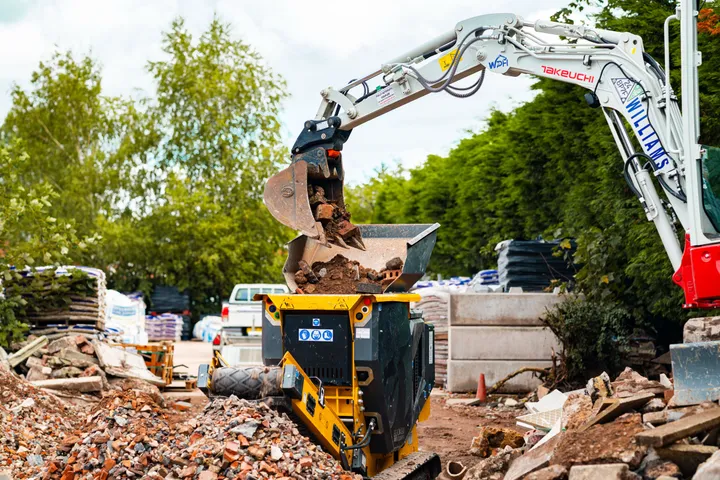
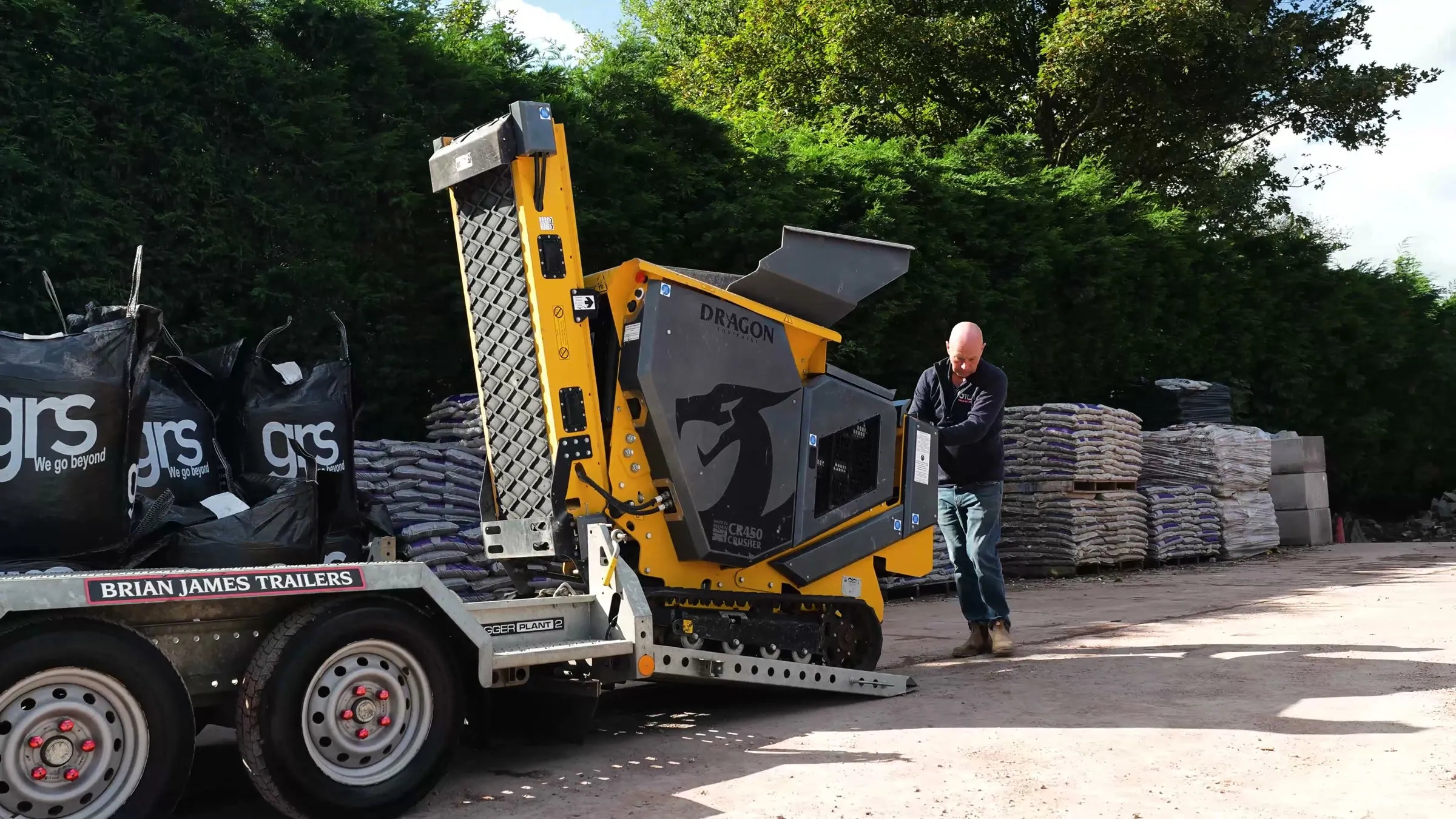
Yes, we deliver the Dragon Equipment CR450 to Church Stretton, All Stretton and Little Stretton. Our yard at Ford is about 18 miles north, and the run is the A5 round Shrewsbury and then straight down the A49, roughly half an hour. Once it's unloaded, Neil runs through the controls with you, and we fetch it when you're done.
- From our yard
- About 18 miles · 30 mins
- Route
- A458 and A5 round Shrewsbury, then the A49 south
- Council
- Shropshire Council
- Waste regulator
- Environment Agency
Why does crushing on the plot suit Church Stretton?
Space is the problem. The council's 2013 conservation appraisal describes the town as lying in a valley half a mile wide, between the Stretton Hills to the east and the Long Mynd to the west. The A49 and the railway take up much of the valley floor, and the houses climb both slopes. Every part of the town sits inside the Shropshire Hills National Landscape, the area known until November 2023 as an AONB.
That makes moving waste awkward. A skip wagon on Trevor Hill or Madeira Walk has little room to stand and a steep road to climb, and each load of broken concrete you send away is matched by a load of stone you have to bring back. Crushing on the plot cuts both journeys, and the CR450 is narrow enough to walk up a garden path.
What did the Edwardian building boom leave on the hillsides?
Large houses on difficult ground. The railway reached the town in 1852, a hotel opened on High Street in 1865 and the Hydro followed in 1902. Land companies formed in 1898 and 1899, and the appraisal calls the first ten years of the twentieth century the town's heyday. The council's Place Plan notes the old nickname, Little Switzerland. Wealthy buyers built substantial villas on steep plots to get the views.
Hazler Crescent and Watling Street keep the most consistent Edwardian character, while Cunnery Road and Madeira Walk show how hard the slopes were to build on. Valuation Office data for the town and its edges counts 540 homes from before 1900, 180 from 1900 to 1918 and 720 built between 1945 and 1972, mostly on post-war estates. Old terraces, retaining walls, garage floors and drives all crush well.
How much new housing is planned for the Strettons?
Very little by Shropshire standards. The 2015 SAMDev Plan set a guideline of about 370 homes from 2006 to 2026 and deliberately cut the build rate to roughly 13 a year because of the protected landscape. Of its two allocations, the school playing fields site is now listed as unavailable, while 43 homes have been permitted and started on the Battlefield land behind Oaks Road. The council counts 242 completions since 2006.
The next big test is Snatchfield Farm off Chelmick Drive, where Northern Trust applied in early 2026 for up to 75 homes. It drew hundreds of objections and has been called in to the Southern Planning Committee; we have not seen a decision. A neighbourhood plan went out for pre-submission consultation in February and March 2026, and the county's draft Local Plan was withdrawn in July 2025.
What are the ground and access challenges on Stretton sites?
Gradient comes first. On Madeira Walk the appraisal describes houses well above the road on one side and well below it on the other, and Trevor Hill drops through retaining walls and hairpin bends towards Carding Mill Valley. Measure gateways and check whether a ramp or a level standing area is needed before delivery. A tracked machine copes with a slope better than a wheeled skip, but it still needs firm ground.
Down on the valley floor the soils are alluvial, and much of that land has never been built on because it floods. The Church Stretton Fault also runs along the valley, and the playing fields allocation sits over groundwater Source Protection Zones 1 and 2. Church Stretton, All Stretton and Little Stretton each have a conservation area, so ask Shropshire Council before altering walls or outbuildings.
How do hill farms around the Long Mynd use a crusher?
Farming here is mostly livestock. The Shropshire Hills management plan puts pasture-fed stock first, with some dairying and arable on lower ground. Up on the Long Mynd, the National Trust explains that the common is grazed by commoners' sheep and ponies, each flock hefted to its own patch. The commoners have been in an environmental stewardship scheme since 1999, and the common is an SSSI.
The hill farms below it, around Minton, Cardington, Hope Bowdler and Rushbury, still rely on concrete for handling pens, feed areas, sheds and the tracks between them. When a pen floor breaks up or an old building is cleared, the rubble can go through the jaw and be laid on a wet track or gateway. That saves bringing stone in along the narrow lanes.
What do people crush in Church Stretton?
Villa drives on the hillside roads
On Cunnery Road, Madeira Walk or Burway Road, a worn Edwardian-era drive or terrace can be broken out and crushed on the plot, then relaid as base. There's no wagon to reverse up a steep, narrow road.
Post-war estate drives and patios
Around 720 local homes date from 1945 to 1972. Their original concrete drives, paths and garage bases are now over 50 years old and make good, consistent crushing material for a new sub-base.
Hill-farm pens and tracks
On livestock farms in the Strettons and Apedale, cracked pen floors and old shed bases can be crushed into hardcore for patching farm tracks and gateways that cattle and quad bikes have churned up.
Brownfield infill within the town
With few allocated sites left, much building happens on small plots inside the development boundary. Clearing an old outbuilding or yard and crushing the rubble gives the builder fill for the new footings and paths.
Do you need a permit to crush concrete in Church Stretton?
Crushing concrete, brick or tile with a machine is a regulated activity, even on your own site, and on a self-hire the person running the crusher is treated as the operator. Before you start, contact Shropshire Council. The council decides whether the job needs a mobile plant (Part B) permit, or whether it is small enough to register a T7 exemption with them instead.
Reusing the crushed material on the same site is normally covered by a U1 exemption, registered with the Environment Agency, which has charged for exemptions in England since July 2025. Keep asbestos, plastics, timber and metal out of the feed. We’re happy to talk it through when you book, but the council has the final say.
Where around Church Stretton do we deliver?
- All Stretton
- Little Stretton
- Minton
- Marshbrook
- Acton Scott
- Hope Bowdler
- Cardington
- Leebotwood
- Longnor
- Woolstaston
- Smethcott
- Picklescott
- Rushbury
- Eaton-under-Heywood
- Plaish