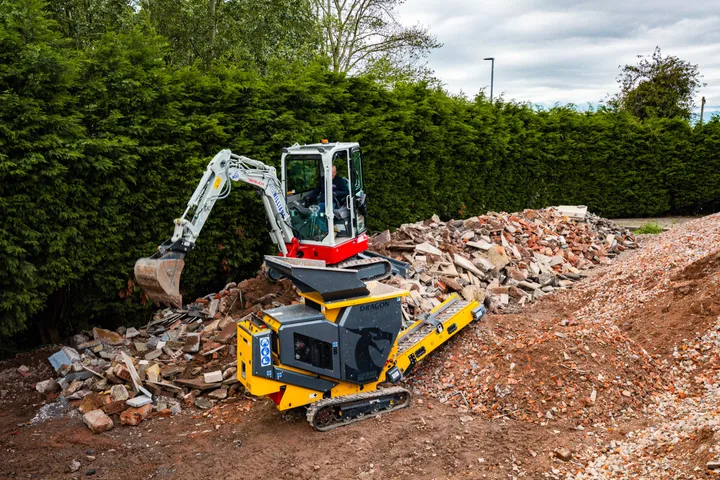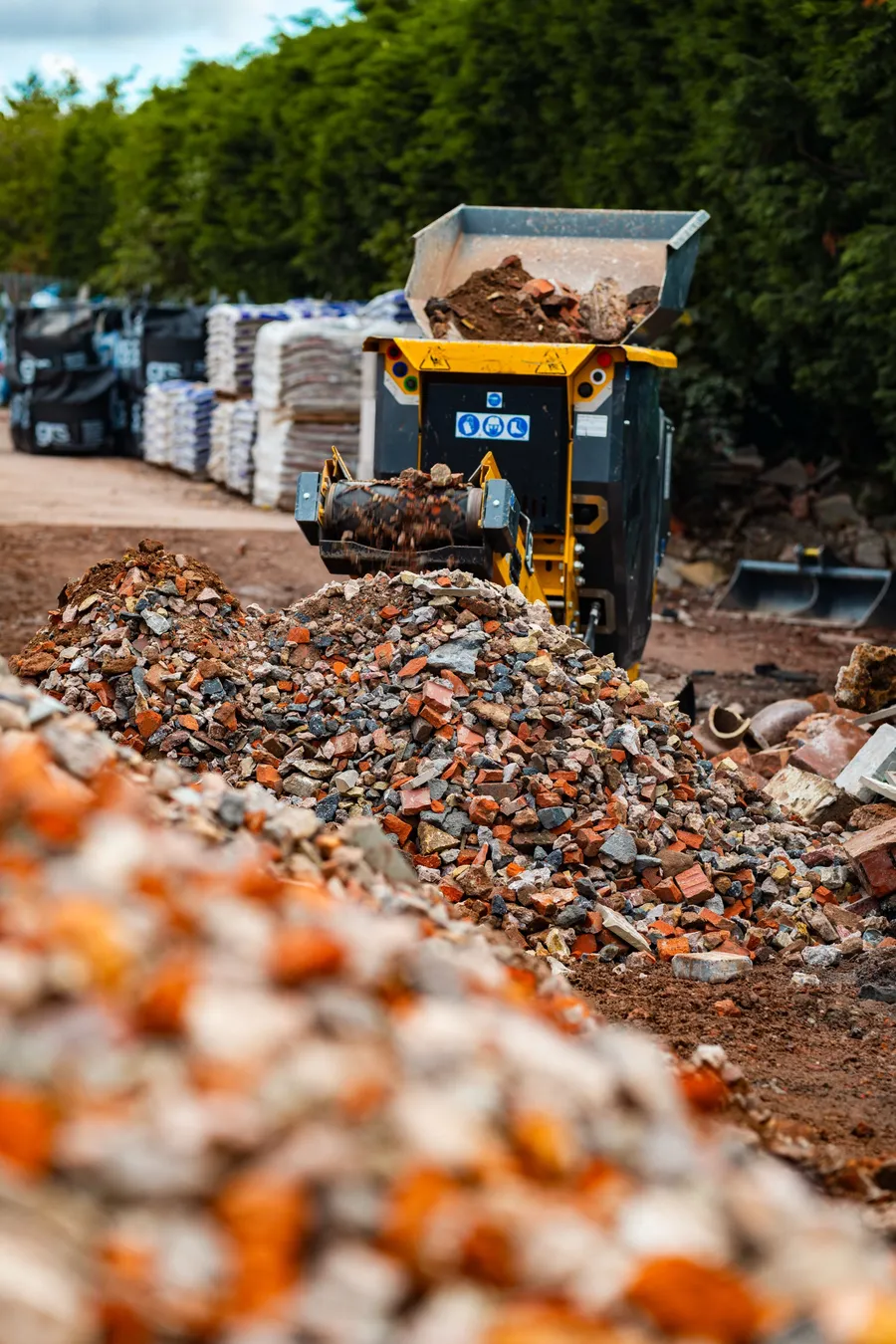
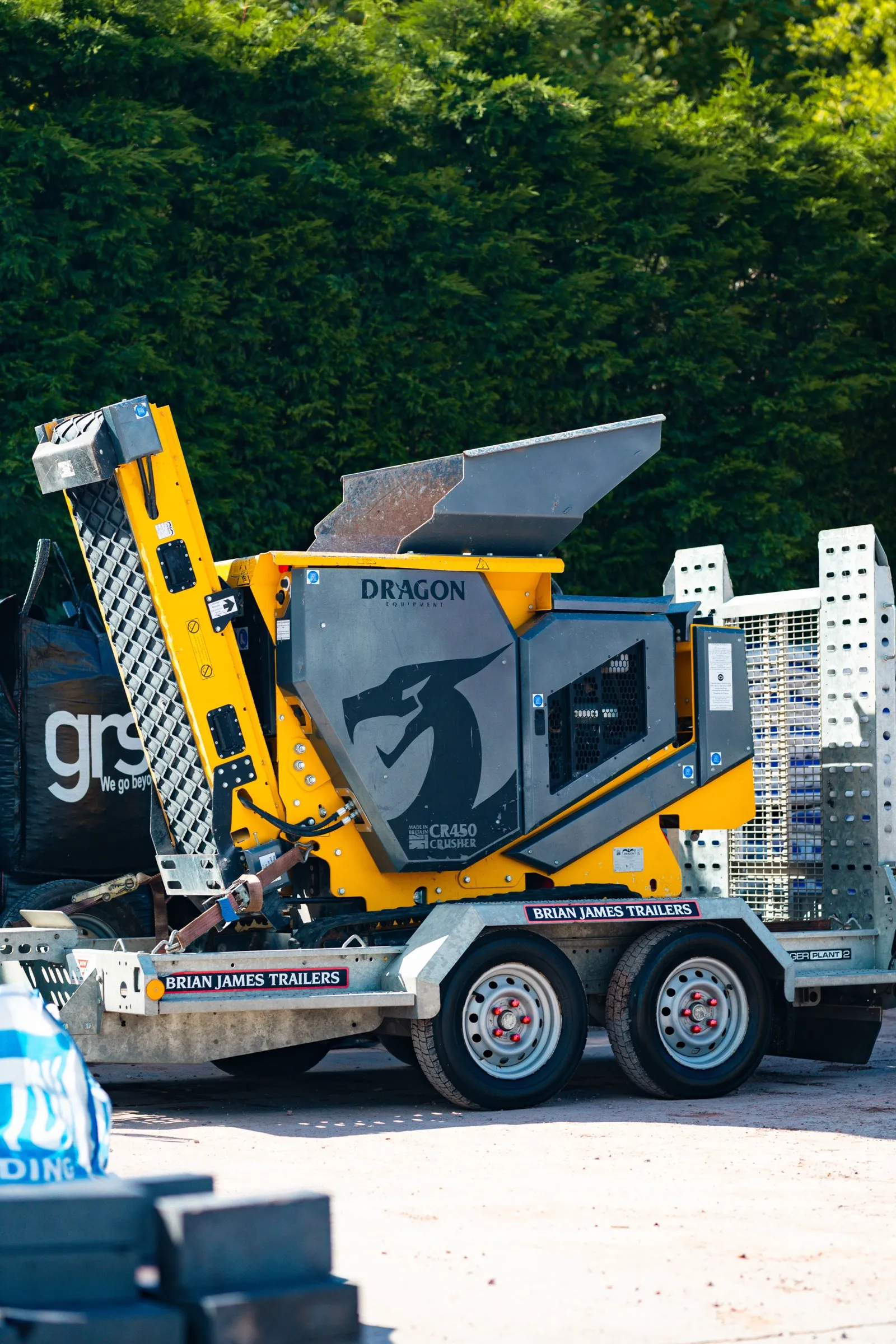
Yes, we deliver the Dragon Equipment CR450 crusher to Bridgnorth, High Town and Low Town alike, and to the villages around it. From our yard at Ford it is about 27 miles along the A458 through Much Wenlock, roughly 45 minutes towing. Neil unloads it on site, takes you through the controls and safe use, and picks it up afterwards.
- From our yard
- About 27 miles · 45 mins
- Route
- A458 and A5 round Shrewsbury, then the A458 east via Much Wenlock
- Council
- Shropshire Council
- Waste regulator
- Environment Agency
How does a town split by a cliff change the way you deal with rubble?
High Town stands on soft red sandstone above the Severn, and Low Town sits at the bottom by the water. The two are joined by streets as steep as Cartway and Railway Street and by medieval flights of steps such as St Mary's and Stoneway. A 1990 survey counted 36 caves cut into the ridge. Getting a grab lorry up and down that slope for every load of broken concrete, then another wagon back with stone, is slow work on a tight street.
The old Severn bridge was the only river crossing until the bypass opened in 1984, and the Cliff Railway of 1892 carries passengers, not plant. A tracked machine 970mm wide needs one delivery and one collection. The main growth areas are easier still: Tasley is west of the A458 bypass and Stanmore lies about a mile east beside the A454, so neither job needs a trip through the historic core.
Which Bridgnorth homes give up the most concrete?
The oldest fabric is in High Town: the 1650 Town Hall standing on arches over the High Street, Bishop Percy's House of about 1580 in Cartway, and the older houses along East Castle Street. Victorian and Edwardian houses then spread out past the old gates along Salop Street, Pound Street and Railway Street. Those terraces and pairs tend to have yard concrete, brick outbuildings and garden walls that have been patched for a century.
Growth picked up after the Second World War, when the town became popular with commuters to the West Midlands. Oldbury, folded into Bridgnorth in 1967, and the Hook Farm area are typical of that later spread. The 2021 census across the two town wards counts 2,095 semi-detached households, the largest single type, plus 1,920 detached. Most of those come with a concrete drive, a garage base or a patio that will eventually be dug out.
Why is so much of the new building going in at Tasley?
Shropshire's SAMDev plan set Bridgnorth around 1,400 dwellings for 2006 to 2026 and about 13 hectares of employment land. It also admitted the town had little option but to grow north west, because Green Belt, topography and landscape block the other directions. Tasley took the allocations: 200 homes north of Wenlock Road, about 300 north of Church Lane, a business park south of the A458 and 6.6 hectares to move the livestock market.
Crest Nicholson won reserved matters in 2025 for 323 homes there and is preparing to launch sales. Bloor Homes and Taylor Wimpey's outline scheme for up to 1,500 homes at Tasley Garden Village went to the southern planning committee in February 2026 with an officer recommendation to approve. Shropshire's draft Local Plan was withdrawn in July 2025, a new plan to 2046 is only at scoping, and land supply stands at 4.61 years, so the pressure on Tasley is unlikely to ease.
What should you plan for in Low Town and the conservation area?
The Environment Agency runs a flood warning area for the Severn at Bridgnorth, and Low Town takes the water. In February 2020 Storm Dennis pushed the river to about 5.04 metres, Riverside was closed and homes on Underhill Street were among those flooded. High water came back in December 2023 and October 2024. Ground-floor slabs, yards and walls along the river get broken out after these events, and the space to stockpile rubble is tight.
Most of the old town is inside the Bridgnorth Conservation Area, designated in 1971 and extended three times since, covering High Town, Low Town and the river. Around 250 buildings are listed. Before you take out a wall, a yard or a historic surface in the conservation area, check with Shropshire Council what consent you need. If consent is not an issue, processing the rubble where it lies spares the steep lanes and the riverside road a stream of lorries.
What does Stanmore's RAF past mean for yard work today?
Stanmore Industrial Estate was RAF Bridgnorth, a recruit training camp that opened in 1939 and closed in the early 1960s. The site is now part business park and part country park, and SAMDev keeps it for business and industrial use, inset from the surrounding Green Belt, with a further 2.8 hectares committed. Fabricators, couriers and engineering firms work there, and plans for five new units were lodged in 2024.
Old camp ground and decades of industrial use leave a lot of concrete: yard slabs, loading areas and the bases of long-gone buildings. When a unit changes hands or a yard is enlarged, the cracked slab can go through the jaw on the spot and return as the bed for whatever is laid on top. The same applies at Faraday Drive and the Bridgnorth Aluminium campus on Stourbridge Road, the other employment land the plan protects.
What do people crush in Bridgnorth?
Haul roads and plots at Tasley
Groundworkers opening up land west of the A458 bypass often find old hardstanding, farm concrete and footings. Crush it on the plot and use it for temporary haul roads or sub-base, without sending wagons back through town.
Refits on Stanmore Industrial Estate
Former RAF camp ground and worn industrial yards at Stanmore produce plenty of broken slab. Crush the damaged hardstanding beside the unit and lay it back under the new yard surface.
Clearing up after a Severn flood
When Riverside or Underhill Street properties replace flood-damaged yards, floors or garden walls, clean concrete and brick can be crushed close to where it came out. That means fewer loads up and down Low Town's narrow streets.
Yards on livestock farms
Farms that sell cattle and sheep through Bridgnorth market at Tasley often have cracked yard and collecting-area concrete. Break it out, crush it to size and spread it on farm tracks and gateways.
Do you need a permit to crush concrete in Bridgnorth?
Crushing concrete, brick or tile with a machine is a regulated activity, even on your own site, and on a self-hire the person running the crusher is treated as the operator. Before you start, contact Shropshire Council. The council decides whether the job needs a mobile plant (Part B) permit, or whether it is small enough to register a T7 exemption with them instead.
Reusing the crushed material on the same site is normally covered by a U1 exemption, registered with the Environment Agency, which has charged for exemptions in England since July 2025. Keep asbestos, plastics, timber and metal out of the feed. We’re happy to talk it through when you book, but the council has the final say.
Where around Bridgnorth do we deliver?
- Tasley
- Oldbury
- Quatford
- Danesford
- Eardington
- Astley Abbotts
- Morville
- Worfield
- Claverley
- Alveley
- Chelmarsh
- Highley
- Stanmore
- Ditton Priors
- Acton Round